Supporting Australia’s Renewable Energy Future While Protecting Wildlife
As Australia accelerates its transition to renewable energy, it’s becoming increasingly important to ensure that new developments are designed with nature in mind. Accordingly, the Australian federal government recently launched RERI: The Renewables Environmental Research Initiative – DCCEEW).
RERI is a program that supports the environmentally responsible development of renewable energy projects, while helping to protect Australia’s unique biodiversity. By funding targeted research, the initiative aims to answer important ecological questions, improve environmental assessments, and provide practical guidance that helps balance renewable energy development with conservation outcomes.
As part of this initiative, North Barker was invited by the University of Tasmania to contribute to the RERI project Species Research and Guidance: Tasmanian Birds. The project focuses on improving our understanding of two threatened species—the Tasmanian Wedge-tailed Eagle and the Tasmanian Masked Owl—which may be affected by renewable energy developments. By investigating how these birds move through the landscape, including how often they enter wind turbine rotor-swept zones and what influences their flight behaviour, the research will help produce practical guidance to support more effective environmental assessments and better-informed planning decisions.
One of North Barker’s key contributions has been helping to investigate a challenge familiar to many field ecologists: how accurately can observers estimate the height and distance of birds in flight? These estimates underpin many collision risk assessments for wind farms, yet they rely heavily on the judgement and experience of individual observers. Understanding and reducing observer bias is therefore an important step towards improving the quality and consistency of ecological data.
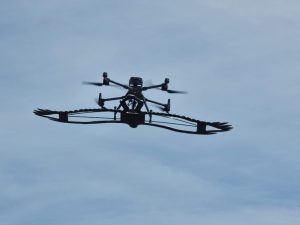
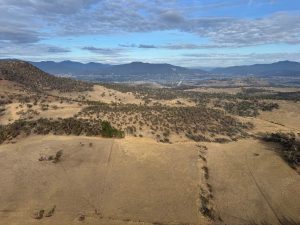
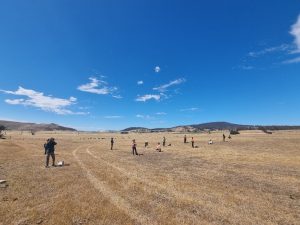
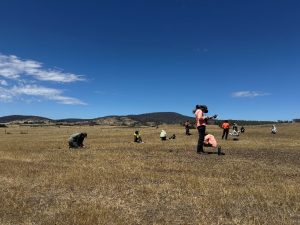
To explore this, around a dozen North Barker staff travelled to the central highlands for a unique field experiment designed to test observer accuracy. Working as a team, participants took part in a blind calibration exercise where they looked away while a drone pilot positioned a drone at a random height and distance. Once the drone was in place, observers located it and independently estimated its height above the ground and its distance from their position. Because the drone’s true location was known, researchers could compare each estimate against the actual values and assess both accuracy and consistency across observers.
The data are currently being analysed, but the early findings are promising. Initial results suggest that observer calibration exercises can substantially reduce estimation error, improving the consistency and reliability of field observations. If these findings are confirmed, they could help establish calibration as a simple but valuable component of bird survey programs, ultimately strengthening the evidence used to assess potential impacts of renewable energy developments on threatened species. This is consistent with our recommended approach on recent utilisation surveys, in which we incorporate seasonal calibration exercises for field teams to hone their skills on target species and in representative conditions prior to formal surveys. Having our survey data accurately represent real world conditions and risks to species is a vital part of what we strive for, and we are excited to keep advancing this space.
North Barker is proud to be contributing to research that not only advances ecological science but also helps ensure Australia’s renewable energy future is built on robust, evidence-based environmental assessments.